
Helping Independent Advisors Transition $2B+ in assets
Designing a white-glove custodial service for an investment bank entering a new market.
TL ; DR
background
A 150-year-old global investment bank entering the US independent advisor custody market with a first-of-its-kind custodial offering.
team
2 UX Designers (including me) · 2 Management Consultants · 1 Subject Matter Expert. I owned research, concept direction and strategy; interaction architecture visual execution was shared.
Problem
Advisors were spending more time managing the bank's operational processes than advising their clients.
Approach
Research to locate where the bank's processes were costing advisors time and trust. Parallel journey mapping to find the coordination failures behind them. POC interface flows to validate the highest-impact fixes.
Outcome
$2B+ in client assets committed for transfer via signed Letters of Intent, secured by the bank’s team using the validated POC screens, UX strategy and the GTM strategy in institutional pitches.
impact
-
$2B+
Client assets committed via signed LOIs
-
~65%
Fewer compliance rework cycles per account (Projected)
-
~40%
Faster account opening and asset transfer (Projected)
context
Switching custodians can be tricky
Who is an Independent Advisor?
A wealth manager who runs their own firm, managing investments for high-net-worth clients without institutional affiliation.
What is a custodian?
The financial institution that holds those client assets, processes transactions, and manages the regulatory infrastructure behind the scenes.
Why is switching risky?
Client assets are frozen during transfer
A single compliance flag or missing document can stall an account for weeks
- Clients hold the advisor responsible, not the custodian
Advisors switch rarely. This makes the bar for a new custodian exceptionally high.
validation & outcomes
Validating commercial value and transitioning to build
We delivered a comprehensive package to the client’s product and engineering teams for technical build. During the scoping phase, the GTM team leveraged the validated POC screens to secure immediate asset transfer commitments through Letters of Intent.
Commercial Validation: Interactive screens successfully proved to institutional prospects that the platform would eliminate legacy operational friction.
65% fewer compliance rework cycles: Shifting COSIMA screening upstream drops average cycles from 1.4 to under 0.5 per account.
40% less manual onboarding effort: The Digital Vault and structured requests completely replace manual emails and data re-keying.
30% faster end-to-end onboarding: Achieved through the combined speed of pre-checks and automated workflows.
We structured the final performance framework into distinct categories to help internal teams measure long-term product success.
User-Centric Metrics
- Faster Onboarding: Tracks the ratio of successfully opened accounts versus attempted opens. It also measures early compliance sign-off driven by the day-one pre-check.
- Reducing Manual Tracking: Monitors the drop in daily portal logins for status updates as the Activity Tracker becomes the primary signal. It also tracks the elimination of spreadsheet workarounds as the hub replaces three legacy portals.
- Building Advisor Confidence: Gauges the post-onboarding Net Promoter Score (NPS) with the custodian. It also evaluates the percentage of support queries resolved on first contact by analyzing automated assistance against escalation ratios.
Product and Business Metrics
- Increasing Onboarded AUM: Measures the volume of new assets custodied per month and total asset migration value. It also tracks the acquisition rate and onboarding frequency of new independent advisory firms per quarter.
- Optimising Operational Efficiency: Monitors the decline of exception rates during the KYC stage to reduce total rework cycles per opened account. It also tracks the drop in support escalation rates by comparing automated resolutions against total ticket volume.
approach
Setting direction
Senior stakeholders had set the white-glove bar before the engagement began, and anything less would contradict what 150 years of the name promised.
Navigating through the unknowns
To ensure competitive differentiation, I championed an upfront research phase to
- map why advisors were frustrated with legacy custodians,
- uncover qualitative market gaps, and
- pinpoint the highest-impact opportunities for value creation.
A peek into the findings
Advisors re-entered data their current custodian already stored in its own systems


Compliance documents were managed over email with no shared status
Status updates required daily manual logins because the system surfaced nothing automatically


Multiple disconnected portals meant no unified view of any client book
Support was unavailable at the moments when advisors most needed it

user groups
..So who are we designing for?
Mark (independent advisor)
Primary
“If I had to change custodian, the offering would have to be mind boggling.”
- $2.2B AUM across ~100 HNW and UHNW clients
- Custodian only meets partial needs
- Disconnected tech stack hindering efficiency and productivity
- Lack of automation of key processes leading to manual data entry
- Complicated account opening and transferring leads to poor client experiences and trading delays
Joanne (Client Service Associate)
Secondary
“I want my client investor to do as little as possible.”
- Strives to build and retain client loyalty despite custodial presence (part of Mark’s firm)
- Lack of visibility to custodian back offices creates delays
- Rigid compliance requirements, red-tape, bureaucracy at custodian
- Labour intensive and redundant paperwork
- Complicated account opening and transferring processes
Hillary (Custodial IA Support)
Secondary
“Our challenge is not the task, but the volume.”
- Supports 200+ independently advised accounts
- Lack of automation of key processes leading to manual data entry
- Expectations for quick turnarounds and time constraints
- Complicated account opening and transferring processes lead to poor IA and client experiences
- Delays in account opening due to COSIMA (internal compliance)
insights
Diving deeper
In-depth interviews with advisors, client service associates, and custodial support staff, triangulated with market and competitor analysis.
sample size
12
Independent Advisors
5
Client Service Associates
9
Custodial IA Support
Post-submission silence was structurally built in. Advisors logged in daily, but clients asked questions advisors could not answer.
“There is no notification system. I have to log in every day just to see if the account has been opened.”
Issues surfaced post-submission. Every flag meant a rework cycle. Rework cycles reset timelines and client trust.
“We submitted everything correctly. Three weeks later they flagged an issue. The client had already been told the account was opening.”
Submissions traced across inboxes. Files could not be found in the review queue. Holds persisted with no shared view.
“By the time I find the right email thread, the client's already called asking why nothing's moved.”
Advisors re-keyed data that existed in internal systems.
“I don't want to bag my own groceries. Custodians should do most of the heavy lifting.”
No single view of the book. Every system required a separate login. Workarounds lived in spreadsheets.
“I have to bill around 258 accounts. The process is not seamless.”
Help only available during business hours. Compliance flags do not respect office hours.
“I hate being stuck on hold when calling custodians to help answer a question.”
prioritisation
Mapping value
By translating pain points into product capabilities, we created a framework of value. Every feature was intentionally designed to restore trust and real-time visibility, replacing the opaque, manual processes of legacy competitors.
| Pain point | Feature | Value | Impact | Effort |
|---|---|---|---|---|
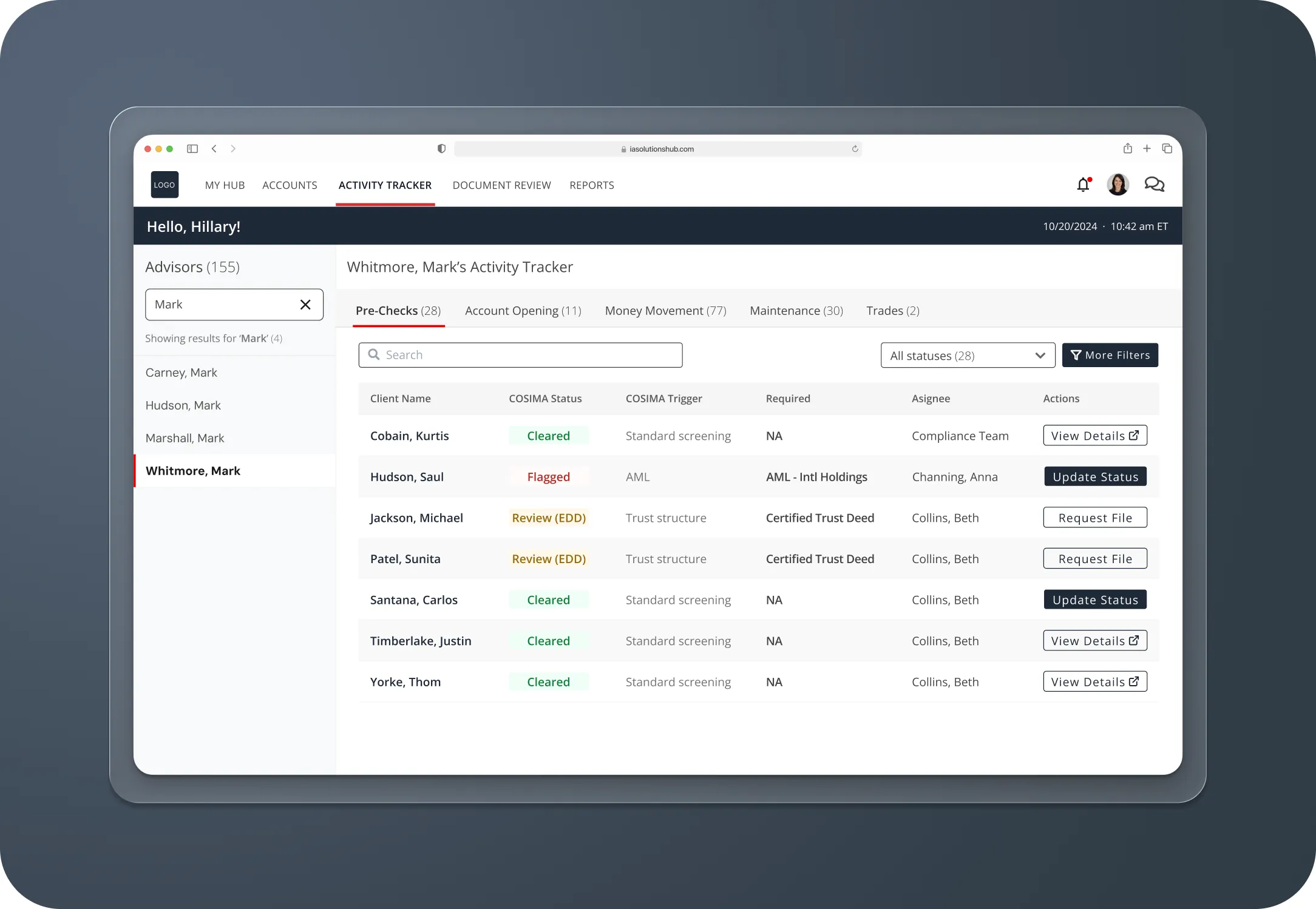
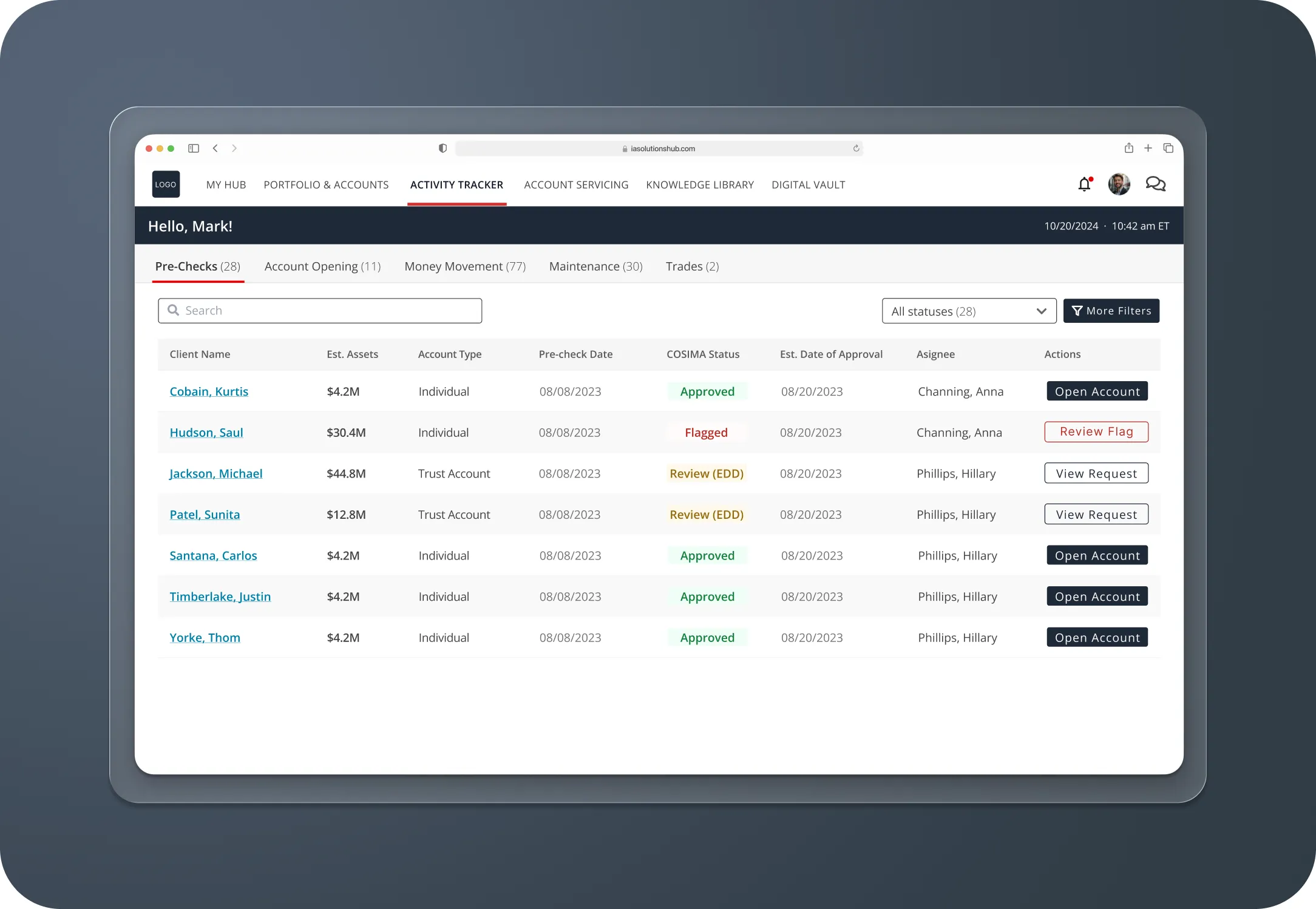
| No visibility into status | Activity TrackerPOC | Establishes radical transparency, transforming the advisor into a proactive client advocate. This shields critical client relationships during high-stress asset transitions. | High | Low |
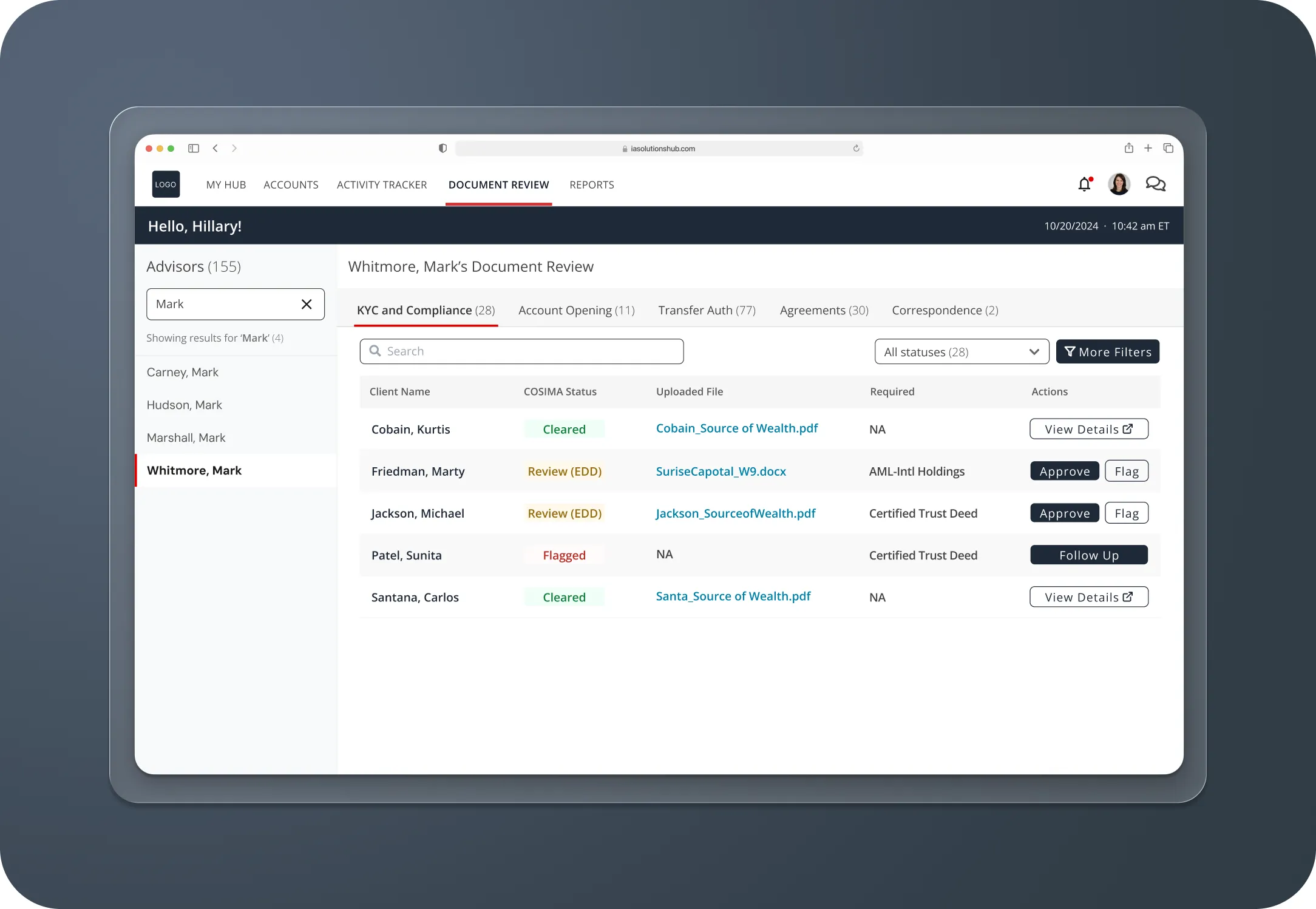
| Late compliance flags | Pre-CheckPOC | Pulls risk assessment to the front of the sales cycle, transforming a historical operational bottleneck into a strategic planning signal. | High | Low |
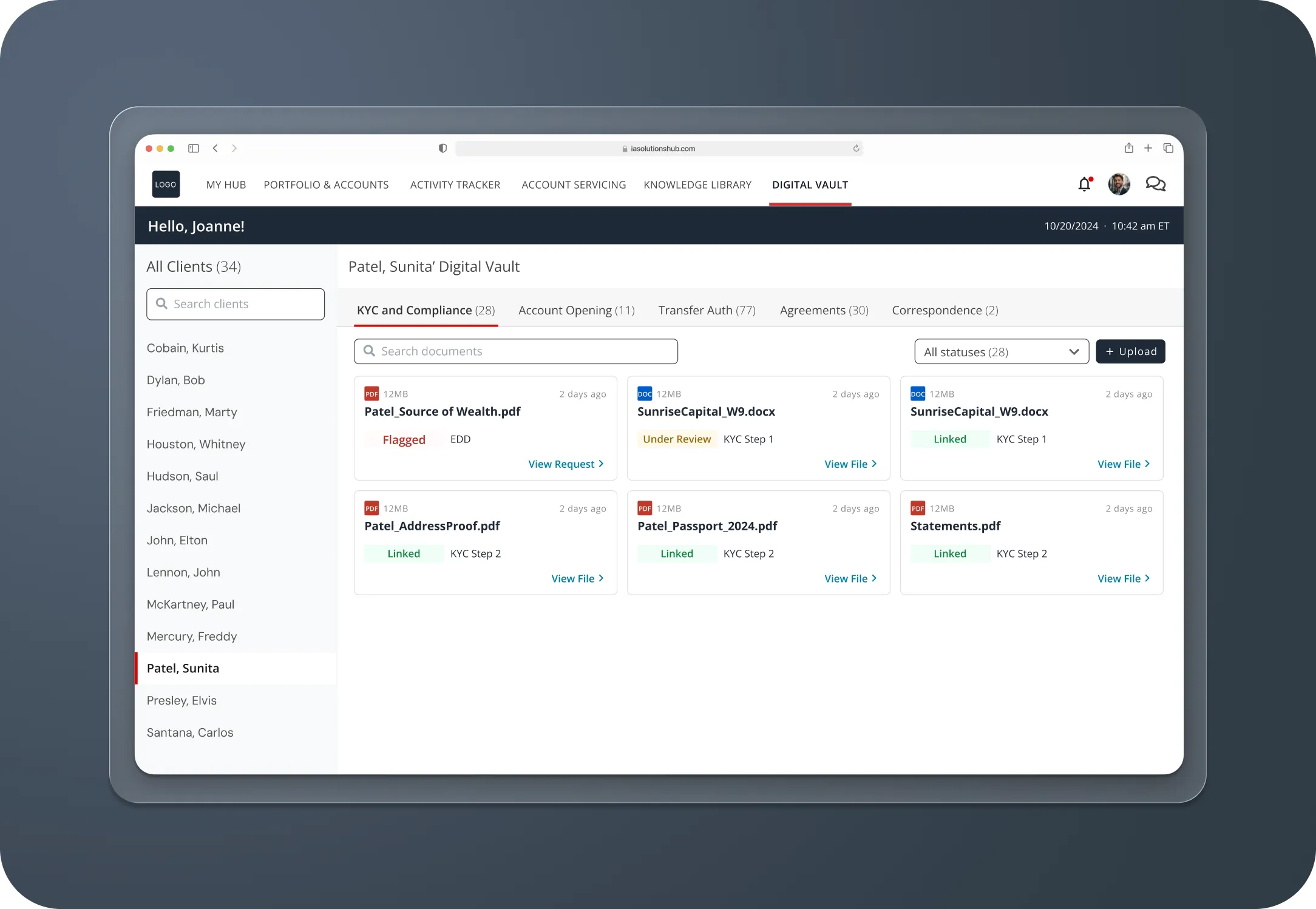
| Documents lost in email | Digital VaultPOC | Consolidates document orchestration in a single secure environment, entirely removing fragile, unencrypted external communication channels. | High | Medium |
| Support gaps | Tiered SupportPOC | Guarantees rapid, context-rich operational resolution during critical, relationship-defining milestones outside standard banking hours. | High | Medium |
| Disconnected portals | Single Sign-On Hub | Delivers a single, unified operational view of the entire book of business, completely eliminating context-switching fatigue. | High | High |
| Re-entering data | Pre-fill System | Enables frictionless, zero-redundancy data pipelines that respect the advisory firm’s operational overhead. | Medium | High |
coordination model
Aligning interdependent workflows
Internal product teams possessed unique, localised visions for the platform. We developed a service blueprint to synthesise those distinct perspectives into a single, shared ecosystem blueprint. I led the workshop.
Our service model connects three distinct roles across the custody lifecycle:
Mark (independent advisor ) Decides
As the primary advisor, he requires high-level relationship assurance.
Joanne (CSA) Operates
As Mark’s associate, she needs tactical transaction workflows.
Hillary (Custodial IA Support) Reviews
As the bank operator, she mandates compliance audit details.
A single operational event impacts all three users simultaneously. However, each user requires different data from that same event.
In legacy custodians, coordination failed due to systemic blind spots:
- One user took action inside a silo.
- The other users remained unaware of the status change.
- Teams relied on manual emails and phone calls to bridge the gap.
poc interface
Targeted value interventions
reflection
Reflections
Scope around decisions, not screens: Audit decision-makers, compliance policies, and system constraints during week one to eliminate reactive redesigns.
Treat alignment as a core deliverable: Factor stakeholder buy-in directly into the roadmap with dedicated time and artifacts, rather than treating alignment as overhead.
Sequence buy-in by operational flow: Map internal incentives early to engage downstream owners (like operational and compliance teams) alongside front-line sales, preventing late-stage delivery stalls.